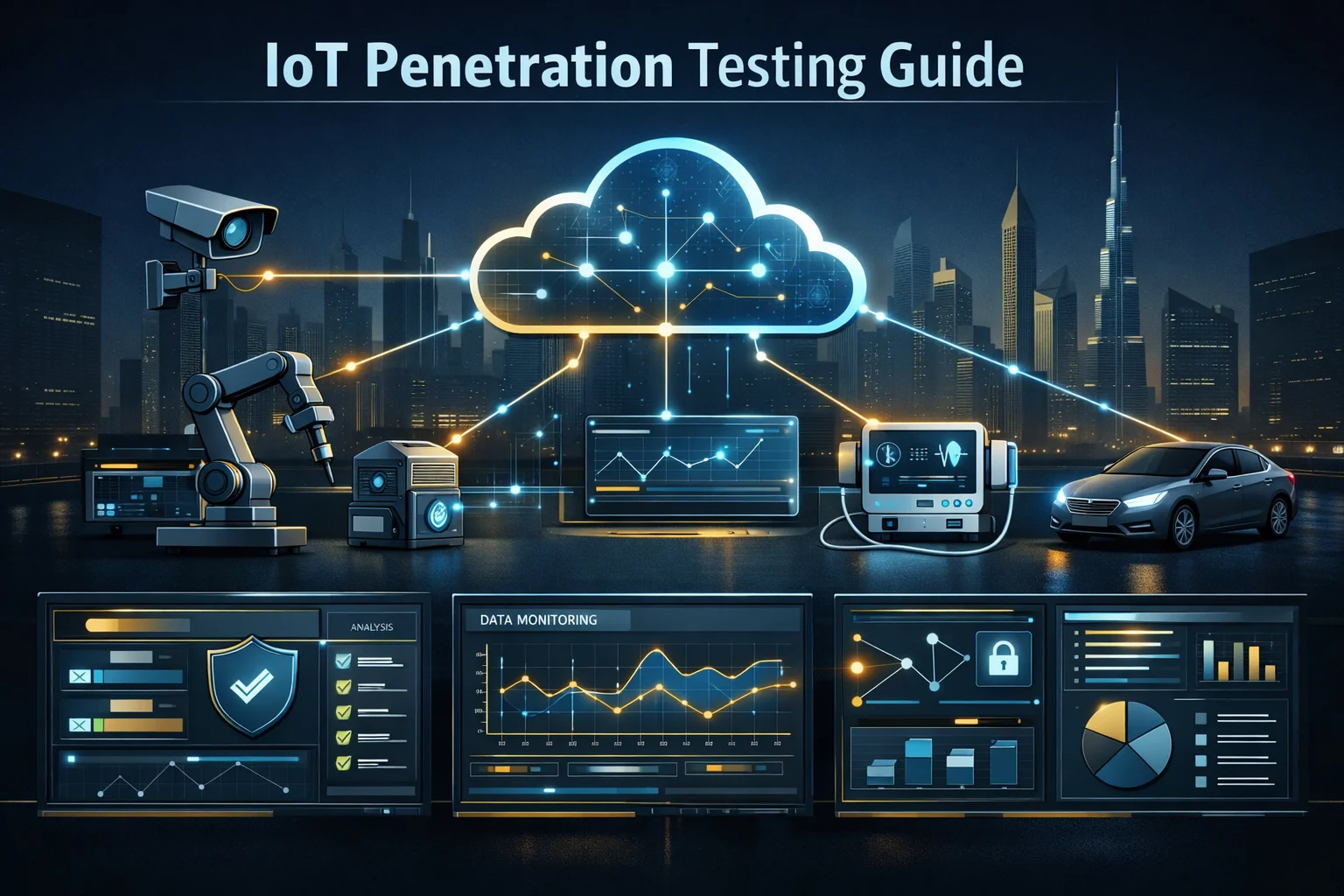
The Classic Guide To IoT Penetration Testing: Challenges, Methodology & Why It Matters
“Hey, we already got our IoT penetration testing done last year.” Okay, but does that make your devices and network fully secure? Nah.
Your IoT devices and network NEED your continuous attention on the system-level and professional penetration testing. Because one single flaw can turn into fleet-level vulnerabilities and easy attack paths for the hackers.
This in-depth IoT penetration testing guide will give you a glimpse into how real-world IoT penetration works, not just theory. Are you ready for a ride?
What is IoT Penetration Testing?
IoT penetration is the process of simulating real-world attacks on your IoT devices and network (Internet of Things) before the real threats shake up your business operations.
Wait…let’s not go with the traditional way of understanding what the heck is IoT penetration testing. Shall we?
As you’re reading this paragraph, look at your surroundings. Can you spot an LED, a smartwatch, a mobile phone, a connected car, or security cameras in your home/office? We bet the answer is YES. Because we’re living in an “internet of things” world.
And guess what? When we’re so heavily surrounded with technology (that’s managing nearly all of our day-to-day tasks), we’d better watch out for the risks, too.
From a simple fitness tracker to supply chain & inventory management, it’s all revolving around IoT devices and networks. And that brings security threats and risks, as a by-product.
That’s where IoT penetration testing can save you from heavy losses before it’s too late to act. Let’s understand IoT penetration testing on a deeper level.
What Does the World Look Like Without IoT Penetration Testing?

Nope, that’s not an exaggeration. Let us paint a hypothetical picture of how deeply it can impact if you don’t consider IoT penetration testing for both the home network & business network.
Let’s look at it industry-wise. Because this isn’t just about “cybercrime”. It’s a far deeper and broader issue than that.
Medical IoT Risks: As the medical industry is equally relying on Internet of Things or Medical Internet of Things (MIoT), overlooking and ignoring the dynamic network vulnerabilities can be dangerous enough to put a patient’s life at risk. And that’s not theory. According to a study published on ResearchGate, EHR systems have 180x, infusion pumps 150x while the common wearables contain 90x number of critical vulnerabilities.
Industrial IoT System Disruptions: The petroleum and power grid industry has adopted IoT-based systems heavily, in the last decade. And that has led to some of the shocking disruptions, such as downtime during working hours because some moron on the internet exploited the overlooked vulnerabilities.
Global Manufacturing Risk: Organizations rely on IoT and SCADA (Superior Control and Data Acquisition) for managing, controlling and monitoring the physical manufacturing process. And it’s reported that every SCADA system faces cyberattacks and exploits on a monthly basis.
We can list a lot more industries such as sustainable manufacturing, energy & power, traffic management, but here’s the key takeaway: Meanwhile, the systems are getting efficient and faster using these physical technologies, it’s high time to start taking IoT security assessment seriously (to make sure that it fails safely).
The EXACT Framework Industry-Leading IoT Pentesters Use
You’re intelligent enough to understand by now that IoT penetration testing is a lot different from traditional pentesting. The attack vendors are highly diverse and the process is sophisticated because you don’t know where to begin your assessment.
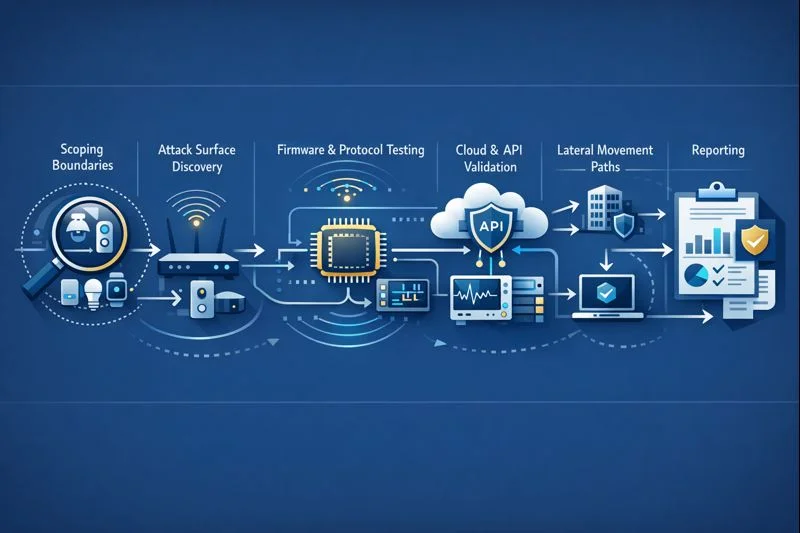
1. Scoping & Damage Control
Contrary to other types of penetration testing such as cloud penetration testing, IoT pentesters are highly concerned for what can’t be tested during the process. Because clients say “Do anything but don’t let the business operations go down even for a second”. And that’s understandable. Hence, it’s as important to note down the systems or devices we can’t touch as the ones we will.
2. Attack Surface Discovery
It’s pretty common to find unknown devices (that are the easiest attack paths for the hackers) during IoT penetration testing. This step involves correlating network traffic, authentication logs and cloud device listings. And here’s how we map it out: device ↔ gateway ↔ cloud ↔ app trust paths.
3. Indirect Device, Firmware & Protocol Testing
Indirect testing refers to testing the device, firmware and protocol without physical access and breaking it down. Because an amateur IoT pentester would want to get access to your device, and then test it (ofc, that’s how they teach in theory 😎). But here’s how the experienced IoT penetration testing company thinks: can we make the device do something unsafe without even seeing its brain?
We look for unverified, unsigned and unprotected updates in firmware. When it comes to protocol testing, we listen to the conversation between devices and servers, copy them, carefully change small parts and send `em back. The purpose is to test if the device would obey the commands from a wrong sender.
4. Cloud, API & Lateral Attach Path Validation
Almost all IoT devices are connected to a cloud platform/remote management system, and that becomes the key attack path for the hackers. They work around it to find vulnerabilities and exploit them. While we work around to find vulnerabilities and secure them before the real attackers reach them.
While testing cloud & API by asking its systems questions they shouldn’t answer. And then, the lateral attach path comes in the line. And it wouldn’t be wrong to call it the biggest factor in this step: because even if a loophole is left undetected, unreported and unfixed, it’s gonna create a lot of trouble, later on.
5. Reporting & Retesting
In our proof-without-damage reporting, we clearly tell our clients what was tested, what was infected, and what couldn’t be validated. And the best part is: none of your business operations gets affected by the IoT security testing.
Because we deeply understand that full exploitation of the proven vulnerabilities is unsafe. And we retest the attack paths, not just individual findings. Plus, recommend compensating controls where fixes can’t be implemented.
The Overlooked Challenges of IoT Penetration Testing
Understanding the overlooked, underrated challenges companies face in performing IoT penetration tests is really helpful for your business owners like yourself. And it helps you judge a penetration testing company way better than those who don’t.
- Silent Failures: Often, IoT devices seem to fail without logs, error messages or even alerts. So, it’s too tough and risky for the pentester to validate whether its crash, a safeguard or a vulnerability is being exploited.
- Fake Environments: It’s hard to get the testing done in a production-like environment (the exact places attackers exploit weaknesses). Contrarily, most of the device security is assessed in labs without real network noise, user behavior or third-party integrations.
- Identity Weakness: Because of the fact that many devices rely on predictable identifiers like MAC addresses or serial numbers. Once one device is compromised, it ends up turning a single flaw into a fleet-wide issue.
- App Overreach: Since mobile apps are the control place for device reset, firmware updates, & pairing, the backend trusts every request because they assume it’s coming from the app.
- State Confusion: IoT device behaves way differently on state and the pentesters must trigger the exact state, at the exact time, without bricking the device and have to reproduce it for reporting. That’s challenging under safe-testing constraints.
- Time Starvation: The clients want meaningful IoT penetration testing while giving a limited time. Long-running fuzzing, persistence and chained attacks are usually cut short before real risk emerges.
- Proof Risk: Fully exploiting IoT vulnerabilities can brick devices or impact real users and that’s the red line. So, pentesters are often forced to stop at partial proof, which doesn’t guarantee long-term device or network security.
Frequently Asked Questions
What does IoT device security testing involve?
If you’re opting for an expert IoT pentester, they would approach IoT device security testing as evaluating the entire attack surface across the device, not just the hardware. It includes the firmware, communication protocols, cloud connections, mobile apps and APIs security testing without disrupting the business operation.
Do IoT penetration testing tools replace manual security testing?
Not at all, because automated testing tools can flag the basic misconfigurations, exposed services and vulnerabilities, and they often miss logic flaws, chained attack paths and real-world abuse scenarios.
What are the 5 examples of IoT devices?
Smartwatches, connected cars, smart thermostats, smart lighting systems, and smart security cameras are the top 5 examples that you’d easily find near you, as a part of your day-to-day life.
What is IoT pentesting?
IoT pentesting is a process of security assessment executed by professional penetration testers, simulating real-world attacks on Internet of Things (IoT) devices. And then spotting known vulnerabilities without hurting the business operations.
That’s A Wrap, People!
Real, solid, and reliable IoT penetration testing is a result of continuous, system-level testing. So, if you’re one of those who rely on just “one-off assessments” as your immunity proof, you need to hear this: treat IoT pentesting results as risk indicators, not “yayy, we’re 100% safe”.
Because these pentests are done in time-constraints, state-dependent and dangerous to fully exploit kinda situations, so you can’t fully rely on such reports. The key takeaway is: you can’t take security decisions based on the IoT pentesting reports, and don’t even think about ignoring IoT penetration testing because that might cost you a fortune, later on.
Stay safe, stay resilient!
PS – Our experienced IoT penetration testing experts are more than happy to help you with auditing your current IoT device or network security condition. Click here to send a query and wait till you hear back from us within 24 hours.