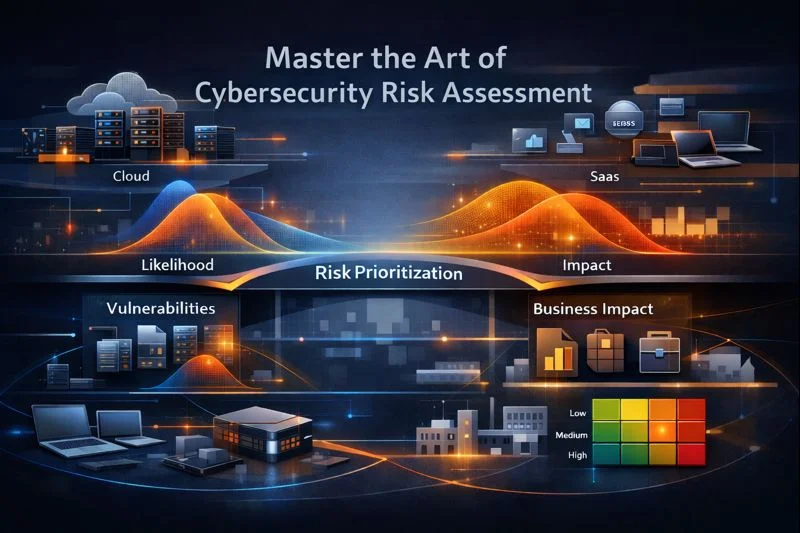
Master The Art Of Cybersecurity Risk Assessment: Different Approaches, Checklist, & Top Threats
If our security team patched everything tomorrow, the business would still be exposed. We’ve seen it happen. Dashboards look clean, tickets get closed, and everyone exhales, right until one overlooked access path takes the hit and the real damage begins. The problem was never effort. It was “focus”.
Modern environments move too fast for surface-level fixes. The cloud changes daily. Access keeps expanding. Attackers don’t care about severity scores; they follow opportunity.
That’s where cybersecurity risk assessment earns its place. It slows the chaos just enough to show what actually keeps the business running and what could stop it cold. Without that clarity, we’re not managing risk. We’re guessing under pressure.
Let’s not keep you guessing, anymore. Ready?
Cybersecurity Risk Assessment Explained
Cybersecurity risk assessment is a process of assessing, quantifying, and filtering the cyber risks for a business digital presence. Unlike security scans or one-off technical security audits, it’s an in-depth, data-driven framework to filter out the risks that are worth fixing first.
This cybersecurity risk assessment helps the organizations look deeper into what exactly the vulnerabilities they have in their systems, network, cloud infrastructure, APIs, remote workspace, and hybrid environments. And how EXACTLY they will impact the business operations in real-time. Not every vulnerability or security flaw is worth fixing because it can’t directly impact your business operations.
In 2026, considering the modern technologies and infrastructure businesses are incorporating in their systems, cybersecurity risk assessment acts like the bridge between the current security risks and its actual threat impacts. And that alone is enough to take it seriously in 2026.
Different Approaches To Cybersecurity Risk Assessment
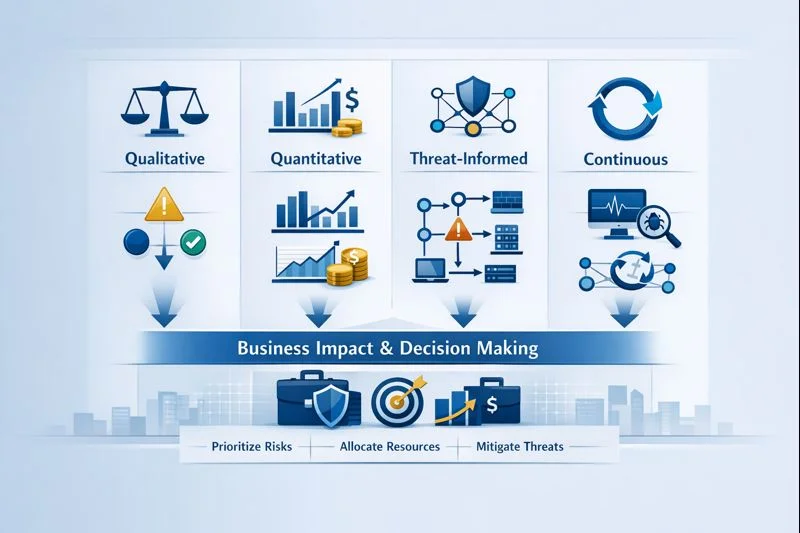
Understanding these cybersecurity risk assessment frameworks will help you make informed decisions aligned with your company’s business environment. Plus, you’ll be able to optimize your resources and budget because every type of assessment is different with completely unique outcomes.
Let’s dive into some of the most used cybersecurity risk assessment methodologies in the market.
1. Qualitative Risk Assessment
Qualitative risk assessment is a framework widely used by A-list cybersecurity companies to quickly highlight the potential vulnerabilities and threats to a company’s digital presence. It’s best for executives who want to understand the risk profile without complicated numbering or just a PDF but a real-brain guiding them through the likelihood and impact of each risk.
The Questions It Helps Answer:
- Which assets could cause serious disruption if compromised?
- Which vulnerabilities are likely to be exploited now, not just in theory?
- What is the perceived business impact if a threat materializes?
Every expert would qualify the same risk (or threats) differently based on their unique experience and knowledge. Qualitative risk assessment is great as a first step but its real power comes when combined with quantitative or threat-informed approaches.
2. Quantitative Risk Assessment
As the name suggests, it QUANTIFY the risks based on their likelihood (the chances to happen) and impact (the damage it will cause). FAIR (Factor Analysis of Information Risk) is the internationally recognized, structured way to quantify the cyber risks.
The Practical Questions It Answers:
- How much financial or operational damage could this threat cause?
- Which risks are worth mitigating vs accepting based on ROI?
- How do security investments compare cost vs avoided loss?
However, even if quantitative risk assessment makes it easier for decision-makers, it’s important to highlight that the context matters a lot. For example, a $1M potential loss on a non-critical system may be less urgent than a $100k loss on a mission-critical system.
3. Threat-Informed Assessment
Threat-informed assessment methodology helps identify the risks exactly the way attackers do. It begins with gathering threat intelligence, mapping out the threat environment and discovering the hidden, real attack paths using frameworks such as MITRE ATT&CK. Moving on, it evaluates the business impact (if it succeeds) and ease of execution. Hence, it helps produce a prioritized list of high-risk threats.
The Questions It Directly Answers:
- What attack paths could allow lateral movement or privilege escalation?
- Which threats are mission-critical, and which are noise?
- Which systems or processes are most likely to be targeted by real attackers today?
It requires skilled analysts and threat intelligence with intensive resources, especially if it’s a complex business environment. The best part about threat-informed assessment: it’s operationally actionable.
4. Continuous Cybersecurity Risk Assessment (CCRA)
CCRA is a process of automated and always-in-progress assessment that discovers the assets, detects misconfigurations, assigns scores based on vulnerability severity and asset critically, and keeps monitoring for new vulnerabilities that can directly impact business operations. Plus, this process involves automated reporting that helps IT teams and executives to see the same up-to-date risk picture.
Questions It Helps Answer:
- Are there any unknown gaps attackers could exploit?
- Has anything changed in our environment that introduces new risk?
- How is our risk posture evolving over time?
Most of the organizations entirely depend on the automated cybersecurity risk assessment tools. Well, we don’t vote for that. We believe in human-power and expertise even if it’s just reviewing the automated reports.
Top 15 Real-World Risks and Threats
Once you (as an executive), and your team understands the ins & outs, and their impact on your business operation, it helps in communicating faster. So, here are the top 15 cybersecurity risks you need to know in 2026.
| Risk / Threat | How It Happens | Likelihood | Business Impact |
|---|---|---|---|
| Ransomware | Malware encrypts critical systems, often via phishing or exposed RDP. | High | Downtime, financial loss, potential regulatory fines, reputational damage. |
| Phishing & Social Engineering | Employees tricked into revealing credentials or transferring funds. | High | Unauthorized access, data theft, financial fraud. |
| Unpatched Vulnerabilities | Software or OS not updated, leaving exploitable flaws. | Medium-High | Data breaches, system compromise, operational disruption. |
| Insider Threats | Malicious or negligent employees misuse access. | Medium | Data leaks, sabotage, intellectual property loss. |
| Misconfigured Cloud / SaaS | Open storage, weak permissions, or API misconfigurations. | Medium-High | Data exposure, unauthorized access, compliance violations. |
| Shadow IT | Employees use unapproved software or devices. | Medium | Data leakage, unmonitored vulnerabilities, compliance risk. |
| Third-Party / Vendor Breach | Breach or misconfiguration in supplier systems. | Medium | Indirect data loss, business disruption, regulatory penalties. |
| DDoS Attacks | Overwhelms network or application resources. | Medium | Service downtime, customer dissatisfaction, revenue loss. |
| Credential Theft / Account Compromise | Weak passwords, reused credentials, or credential dumps exploited. | High | Unauthorized access, lateral movement, data theft. |
| Poor Backup / Disaster Recovery | Incomplete, infrequent, or untested backups. | Medium | Prolonged downtime, permanent data loss. |
| IoT / OT Attacks | Exploiting industrial devices, sensors, or connected machinery. | Low-Medium | Operational disruption, safety hazards, reputational damage. |
| Remote Work Vulnerabilities | Unsecured home networks, personal devices, VPN weaknesses. | High | Data leakage, unauthorized access, malware spread. |
| Mismanaged Access Controls | Overprivileged accounts, stale user permissions. | Medium | Data exposure, internal misuse, regulatory violations. |
| Zero-Day Exploits | Attacks on unknown vulnerabilities. | Low-Medium | Breach, malware spread, operational disruption. |
| Supply Chain Attacks | Compromised software updates or vendor tools. | Medium | System compromise, data theft, reputational damage. |
The Cybersecurity Risk Assessment Checklist
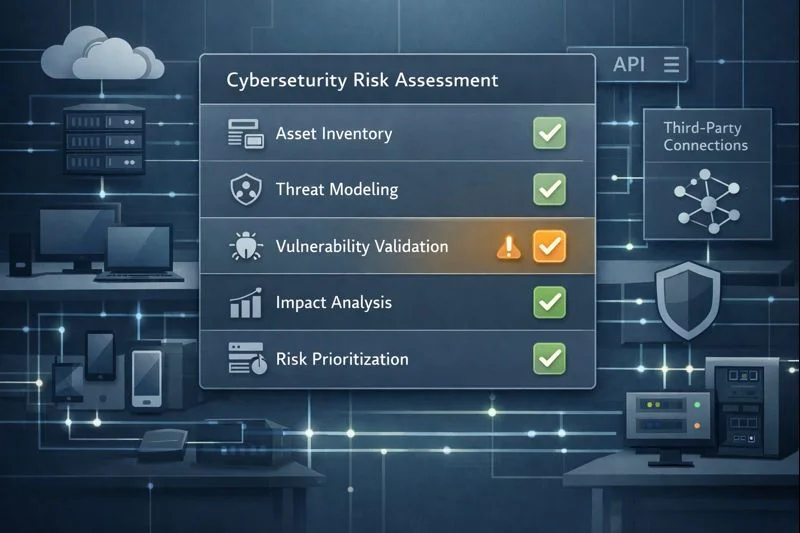
A cybersecurity risk assessment checklist isn’t about just ticking boxes off, rather it’s more about validating what could practically break your business. Here are a few checklist-style steps you can follow for a reliable cybersecurity risk assessment.
- Asset Criticality: It focuses on systems, data and services that directly impact revenue, operations and customer trust (the most imp), not just what exists in your business environment.
- Define asset ownership: Then, clear business and technical owners are assigned so the risk decisions aren’t delayed or ignored during incidents.
- Map technical risk to business impact: This step helps understand deeply how each technical failure has a business impact such as operations downtime, financial loss or regulatory exposure.
- Validate real-world threat relevance: The potential threats or risks are prioritized based on active attacker behavior and industry targeting trends.
- Assess vulnerability exploitability: It’s time to try reaching and exploiting the vulnerabilities in the specific environment.
- Analyze attack paths and lateral movement: After assessing the vulnerabilities, identify how attacks can use hidden paths across the systems, or cloud resources after they’ve broken into your system, initially.
- Review identity and access exposure: Overprivileged accounts, stale users, and unmanaged service identities have to be detected to reduce the blast radius.
- Evaluate cloud and SaaS configurations: Considering how quickly the environments are changing post-AI era, you have to continuously monitor permissions, storage exposure and API access.
- Assess third-party and vendor access: Then, identifying which external parties you’ve allowed to access sensitive data or systems and the impact it can create if they compromise.
- Test response and recovery readiness: A test is considered successful, the backups are recoverable, response plans are defined and recovery timelines match business tolerance.
Cybersecurity Risk Assessment FAQs
What are the best cybersecurity risk assessment tools?
Since cybersecurity risk analysis is an extensive process, it requires a list of tools for specific purposes. For vulnerability & risk management, Tenable.io, Rapid7 InsightVM, QualysVMDR, while ProcessUnity, Bitsight for vendor risk management and OpenVAS, Balbix for specialized security, are the most renowned tools.
What’s the difference between vulnerability assessment and cybersecurity risk assessment?
Vulnerability assessment focuses specifically on identifying and report technical weaknesses, while cybersecurity risk assessment gives a broader and business-centric risk profile by edifying assets, vulnerabilities, threats and their business impact.
What is risk tolerance in cybersecurity?
Risk tolerance refers to the level of risk an organization is willing to accept while pursuing its objectives. Threats are typically labeled as high tolerance, moderate tolerance and low tolerance based on their impact on business operations.
The Bottom Line
Unlike vulnerability assessment, cybersecurity risk assessment is a decision framework, not a one-off security task. When done right, it gives you clarity on what matters most, what can wait, and what must be fixed NOW. So, it helps turn the security burden into a business-enabling process that supports growth and smart investment.
However, in modern environments, continuous assessments and prioritization is what keeps your business thriving in a world of cybersecurity threats.
PS – Care to get a FREE security audit by the “Real-World” cybersecurity experts? Ping us NOW!