
Vulnerability Assessment vs Penetration Testing: Which Is Better?
A hacker tried to break into your system. He failed. You’re saved. But how many more attempts will it take to hack your system, website, application, APIs?
The first simple step you can take towards getting serious with your business security: assess where your current system stands. And that’s what vulnerability assessment does for you.
But how will you see if each vulnerability is exploitable? Penetration testing helps you see clearly through the noise.
By reading this vulnerability assessment vs penetration testing, you’ll get hyper-clear for what your business NEEDS and how you can access it.
Let’s dive in!
What is Vulnerability Assessment?
A vulnerability assessment is a structured process that helps organizations identify and prioritize security weaknesses in their software or network systems. The process aims to identify potential security weaknesses before hackers and malicious actors can exploit them.
Teams use the results to reduce risks while they make security recommendations and improve their protection against emerging threats. Organizations need to spend money on skilled professionals, time, and tools when they want to conduct a complete vulnerability management.
Pros & Cons
| PROS | CONS |
|---|---|
| Automated and easy to use | Only detects known CVE vulnerabilities |
| Quickly identifies vulnerabilities in hours | Limited coverage for misconfigurations |
| Cover multiple assets and deployments | Produce false positives, unreachable vulnerabilities |
| Helps prioritize security risks efficiently |
What Is Penetration Testing?
Penetration testing is also called pen testing, ethical hacking. It helps identify vulnerabilities in systems, networks, or web applications that hackers could exploit. Pen testing assesses risk exposure, tests defense mechanisms, and ensures regulatory compliance. However, complex systems and time constraints make thorough penetration testing challenging and costly.
Pros & Cons
| PROS | CONS |
|---|---|
| Identifies security gaps | High cost due to manual and skilled testing |
| Reveals full attack paths | Limited scale because of a defined scope |
| Tests real-world exploitation | Point-in-time assessment only |
| Detailed mitigation and remediation reports |
How to Conduct a Vulnerability Assessment vs Penetration Testing?
Organizations need to understand vulnerability assessment and penetration testing because both methods help improve their security defenses.
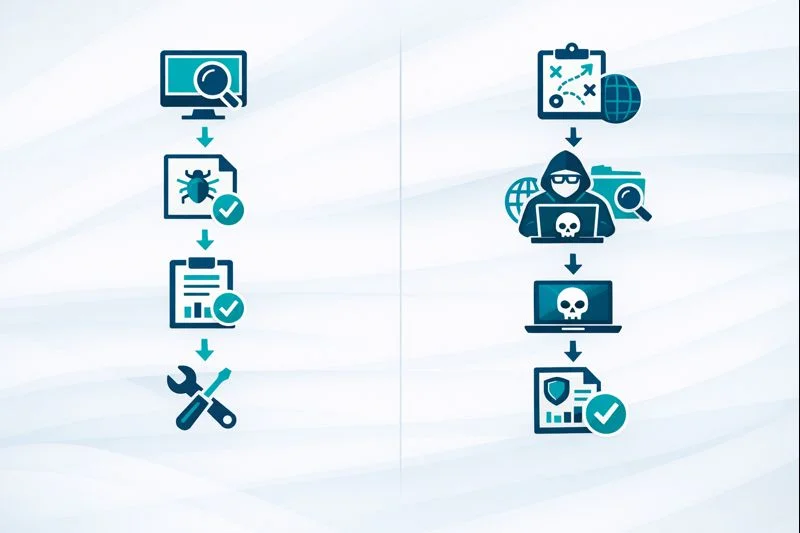
Vulnerability Assessment (VA) Process:
- Planning & Scoping: Decide what systems and networks to check and set clear goals.
- Scanning & Identification: Use automated tools and manual reviews to identify vulnerabilities, misconfigurations, and outdated software
- Analysis: Identify the severity of vulnerability using common standards like CVSS and prioritize which issues to fix first.
- Reporting: Create a report listing all vulnerabilities, their risk levels, and recommendations for mitigation.
- Remediation & Monitoring: Apply fixes such as patches or configuration changes, and continuously assess systems to reduce new risks.
Penetration Testing (PT) Process:
- Planning & Scoping: You should define your goals, recognize possible directions for testing, and obtain permission to have done the tests.
- Information Gathering: Collect both public and internal system data, such as IP addresses, domain info, and network structure, to help inform your assessment process.
- Assessment: Scan for vulnerabilities and manually analyze those vulnerabilities for critical weaknesses.
- Exploitation: Attempt to exploit vulnerabilities using methods like SQL injection, social engineering, or privilege escalation to see how an attacker would exploit the system.
- Reporting: Document which vulnerabilities are being exploited, their potential impact, and provide actionable recommendations for remediation of those vulnerabilities.
- Remediation & Retesting: Fix the vulnerabilities and test again to verify that the vulnerabilities are now fixed.
Difference Between Vulnerability Assessment And Penetration Testing
Here are the detailed differences of vulnerability assessment vs penetration testing that are given below:
| Feature | Vulnerability Assessment | Penetration Testing |
|---|---|---|
| Purpose | Identify and list security weaknesses | Actively exploit vulnerabilities |
| Approach | Automated scanning with limited manual review | Manual and hands-on attack simulation |
| Depth of Testing | Broad coverage of known vulnerabilities | Deep testing of selected high-risk areas |
| Risk Validation | Does not confirm exploitability | Confirms whether vulnerabilities can be exploited |
| Tools Used | Automated vulnerability scanners | Advanced attack tools and manual techniques |
| Impact on Systems | Low risk, non-intrusive | Higher risk due to exploitation attempts |
| Frequency | Performed regularly | Conducted periodically or after major changes |
| Outcome | List of vulnerabilities with severity ratings | Proof of exploitation with detailed attack paths |
Types of Vulnerability Assessment vs Penetration Testing
Here are types of VA and PT that are given below:
Vulnerability Assessment
Here are the types of vulnerability assessment.
| Type | Description |
|---|---|
| Active Assessment | Direct interaction with target systems |
| Passive Assessment | Indirect monitoring without interaction |
| Host-Based Assessment | Testing a single system |
| Internal Assessment | Testing from inside the organization |
| External Assessment | Testing from outside the network |
| Network Assessment | Identifying network vulnerabilities |
| Wireless Assessment | Finding Wi-Fi security weaknesses |
| Application Assessment | Testing web or software applications |
Penetration Testing
Here are the types of penetration testing.
| Type | Description |
|---|---|
| Black Box Testing | No prior system knowledge |
| Gray Box Testing | Limited system knowledge |
| White Box Testing | Full system knowledge |
What Security Policies Do I Need: Vulnerability Assessment vs Penetration Testing
Here are the two policies that you need to try in Vulnerability Assessment vs Penetration Testing:

Vulnerability Assessment Policy
A vulnerability assessment policy explains how your systems are checked for security weaknesses. It helps teams find problems early before attackers can use them.
This policy includes:
- Scope of the assessment
- How often scans are done
- How issues are reported and fixed
Penetration Testing Policy
A penetration testing policy explains how real attack tests are done on systems. The test results demonstrate how well security systems protect against actual security threats.
This policy includes:
- Scope of the test
How often are tests done? - How results are reported and fixed
How Does the Reporting Differ?
Vulnerability Assessment vs Penetration Testing both assist in enhancing security. Their assessment results show different reports and objectives.
Vulnerability Assessment Report
The vulnerability assessment report documents all security weaknesses discovered during the scan process. The report ranks these flaws according to their severity. For example, the report will recommend installing the latest updates to reduce risk.
Penetration Test Report
A penetration test report goes deeper by showing how an attacker could actually use vulnerabilities to break into a system. For example, the report may demonstrate how weak passwords allow an attacker to gain access to sensitive data.
When Should You Use Penetration Testing and Vulnerability Assessment?
Both methods play an important role in cybersecurity, but each is used for a different purpose. The correct method selection results in decreased security risks and enhanced security measures.
When to Use a Vulnerability Assessment Report?
Vulnerability assessments are the best method for regular security checks while managing ongoing security risk.
Use them to:
- Scan systems for known vulnerabilities
- Identify and prioritize security risks
- Manage patches and software updates
- Maintain continuous security visibility
When to Use Penetration Testing Report?
Penetration testing is best for deeper and real-world security testing.
Use it to:
- Simulate real cyberattacks
- Test the effectiveness of security controls
- Confirm high-risk vulnerabilities
- Support compliance or audit requirements
Deciding Between Vulnerability Assessment vs Penetration Testing
The right choice depends on how advanced your security setup is and what level of risk you want to test.
1. Organization Size and Maturity
Vulnerability assessments are used by smaller or younger organizations to identify common security weaknesses. The larger organizations that have reached higher levels of maturity need internal penetration testing. It helps them test actual attack methods and advanced security threats.
2. Budget and Resource Availability
Vulnerability assessments are more affordable, and they need fewer resources which makes them suitable for regular use. The expenses of penetration testing increase because it requires manual work, but it delivers more detailed information about potential attack methods.
3. Security Objectives
Cybersecurity vulnerability assessment provides appropriate monitoring methods that detect risks at any time of the day. Penetration testing provides better results for testing security systems and evaluating the effects of attacks.
4. Compliance and Regulatory Requirements
Many regulations require regular vulnerability scans, while some also demand penetration testing. The selection of the appropriate method needs to consider both the specific industry regulations and audit requirements
Frequently Asked Questions
Does penetration testing give better results than a vulnerability scan?
Penetration testing identifies actual risks by exploiting vulnerabilities. Vulnerability scanning will identify possible issues without testing them.
Which solution works better for your business?
Vulnerability Scanning can be done quickly and is useful for routine checks. In contrast, Penetration Testing helps identify the actual security gaps.
What is the difference between Vulnerability Assessment vs Penetration Testing in cybersecurity?
Vulnerability Assessment is a method that scans systems for potential weaknesses. Penetration Testing is an active form of testing that exploits those weaknesses to identify the actual risks to your organisation.
What are the tools for penetration testing and vulnerability assessment?
Common penetration testing tools include Metasploit, Burp Suite, and Wireshark for exploiting vulnerabilities. Vulnerability assessment tools like Nessus, OpenVAS, and Qualys help detect potential security gaps.
Can both vulnerability assessment vs penetration testing be used together?
Yes, by using both methods together, you will improve your security. Vulnerability Assessments will detect weaknesses, and Penetration Testing will help confirm how those weaknesses could be exploited.
The Bottom Line
Before you drain yourself for hours because of this comparison, just take a deeeeep breath and understand this: the whole point of vulnerability assessment vs penetration testing isn’t to confuse. In fact, both of these are STEPS of securing your business or organization from cyberattacks.
In simple words, a vulnerability report will list down the loopholes in your security while the penetration testing report shows you how far a hacker can exploit THAT loophole. Get it?
Now, if you’re still scratching your head, failing to understand what is the exact next step for you…don’t worry, we are here for you. Ping us today and one of our cybersecurity experts will have an in-depth call with you, for FREE (don’t miss out)