
API Security Testing: Definition, Why It Matters, Checklist and Top 10 Tools
You have secured your apps. Networks? Checked. APIs? Ummm….See, most businesses that are concerned for their security pay attention to their networks, internal and external security, but often ignore the APIs. And that’s what is considered the most sensitive part of your business structure. Because they’re easy to attack while being high-value for your business.
This API security testing guide will help you understand what it is, why it matters, the checklist an experienced API penetration testing company will follow, and the top 10 tools used in it. Shall we?
What is API Security Testing?
API security testing aka API pen testing is a process of assessing security vulnerabilities and exploiting them by malicious actors in a controlled way. When it comes to the specific API aspects, identifying weaknesses in authentication, authorization, input validation, and business login are mainly focused on during API security testing.
Now, you might get confused between API testing and API penetration testing, so here we go: API testing usually involves checking for correct functionality, performance, and integration, while API pen testing is all about assessing the potential security threats.
Why API Penetration Testing Matters a Lot?
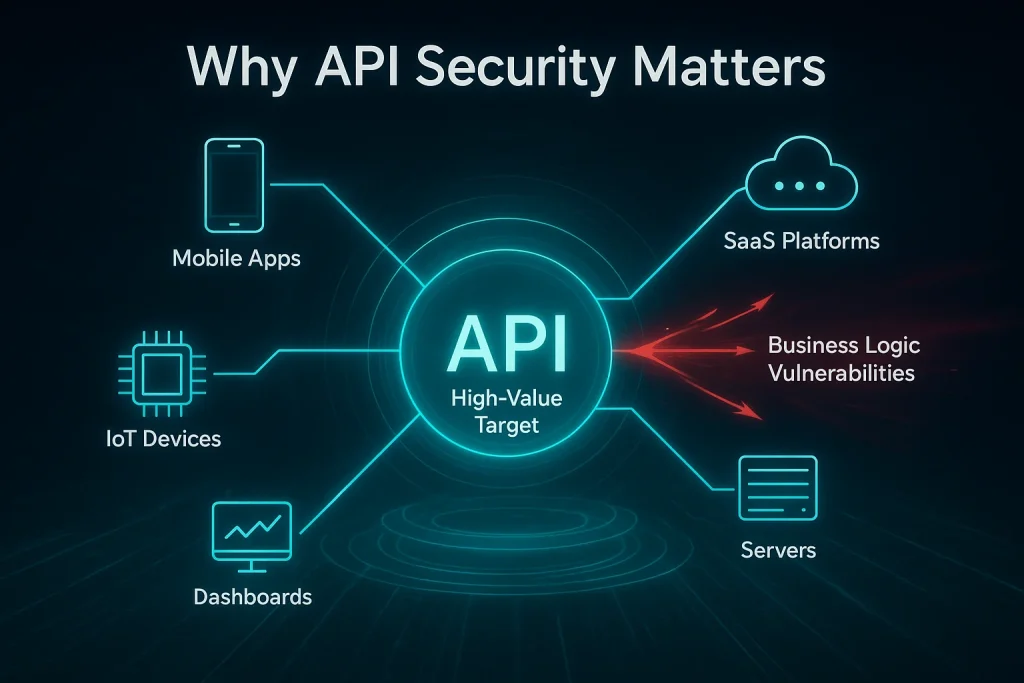
Whether it’s a mobile app, SaaS platform, fintech application, e-commerce systems, IoT devices, or internal microservices, API act like the backbone of the modern digital ecosystems. And usually, the sensitive information, such as user personal info, financial data, and internal business logic, is handled by APIs, which makes them high-value for businesses.
On top of that, most of the business logic attacks aren’t detected by automated tools. And this is where most of the API security vulnerabilities come from, not simple misconfigurations. However, a simple misconfiguration can also lead to excessive data exposure, which is considered the most dangerous API vulnerabilities.
In short, APIs are too important to ignore for businesses, and that’s why testing to see if they’re secure from cybercriminals isn’t an option anymore.
The Ultimate API Security Testing Checklist & Guide You Need
API security testing isn’t just about assessing the vulnerabilities, but a lot more than that. You can’t implement it without a proper strategy and plan. So, we’re sharing the exact API security testing guide, the experienced API penetration tester implements at Haq Security.
1. Reconnaissance & Information Gathering
This is the first phase of the process is all about defining the project scope, setting expectations, and gathering all the information about the API infrastructure. Let’s break it down into 4 steps.
- Identify API Types: Unlike other types of penetration testing, API security testing demands identifying the type of API as a first step. There are a couple of types, such as REST API, GraphQL API, WebSockets, and Internal microservices APIs. Different APIs will have different security risks.
- Documentation Review: In this step, we usually review the Postman collections, API versioning, rate limits, usage restrictions, parameter structures, and WSDL files. And we look for endpoints not requiring authentication, overly permissive parameters, and sensitive operations such as order updates, refunds, etc.
- Endpoint Enumeration: Sometimes, a lot of API vulnerabilities go unnoticed because they exist in undocumented APIs. We uncover hidden weaknesses through brute forcing endpoints using wordlists, discovering shadow APIs left in staging environments, and checking robots.txt or hidden files.
- Identify Technologies: This is where we discover server type, CORS policies, third-party integrations, certifications (HTTPS vs. non-HTTPS), framework or language.
2. Authentication & Authorization Testing
In this phase, it’s mainly divided into 2 portions: authentication testing and authorization testing.
- Authentication Testing: First of all, we check for endpoints that allow no authentication, API key in URL parameters, reusable tokens, and default credentials. Then, we test for expired tokens still working, missing signature verification, and token reuse. And in the end, OAuth flow testing is done.
- Authorization Testing: Authorization refers to what a user can access. BOLA (Broken Object Level Authorization), BFLA (Broken Function Level Authorization), and Mass assignment testing are implemented in this phase.
3. Input Validation & Parameter Tampering
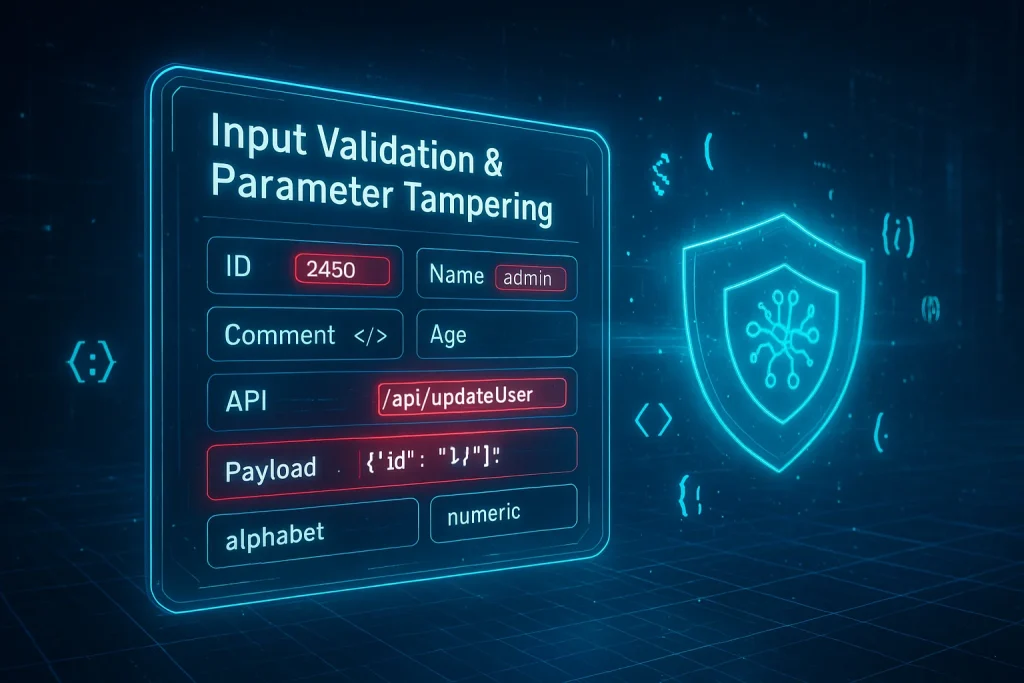
In this step, we test to make sure that the API is handling the user inputs properly and correctly.
- Injection Attacks: We start with SQL Injection to test fields like IDs, filters, search parameters, sort parameters, or blind SQL injection using time delays. NoSQL injection, command injection, and server-side request forgery (SSRF) are also implemented depending on different endpoints and APIs.
- Parameter Tampering: Considering that APIs often fail to enforce strict schemas, we try changing numeric IDs, modifying the request method, and removing mandatory parameters to see if it resists or not.
- Data Type Validation: This is whether we check if the numbers accept text, string length is unrestricted, or enums accept invalid entries.
- File Upload Testing: Once we’re done with the above steps, we go for testing malware upload, script upload, MME type bypass, and content-type tampering.
4. Error Handling & Data Exposure Checks
APIs are known to leak sensitive internal details that attackers use for reconnaissance, and that can be identified before you face a loss by following these steps:
- Error Message Analysis: We mainly look for any stack trace, SQL error, internal file path, debug messages, and raw exception outputs. These are the weak points that help the attackers prepare targeted payloads.
- Sensitive Data Exposure: An API should not return passwords, tokens, IP addresses, server configuration, debug fields, hidden metadata, or internal IDs, and that’s what we test in this step.
- Excessive Data Exposure: We test if the API returns more fields than needed, the response includes internal object structure, and nested objects return unintentionally. You know why? Because this is one of the most exploited API issues.
5. Logging, Monitoring & Reporting
Till now, we have tested all the major endpoints that could give attackers a chance to exploit your APIs and break into your system. In this final stage, we focus on the operational security of the API.
- Logging Validation: As you know, logging failures make breaches harder to detect, so we check if unauthorized attempts are logging, suspicious activity is flagged, such as high volume requests, and sensitive data is not stored in logs.
- Monitoring: To make sure that your system can detect any abnormal behavior immediately, we assess if rate-limit alerts exist, token misuse triggers alerts, and notifications go to security teams or not.
- Rate Limiting: Now, this is where the penetration tester wears their hacker hat and tests brute force attacks, credential stuffing, and high-volume API calls.
- Remediation: We prepare a detailed report including an executive summary, risk rating of vulnerabilities, proof-of-concept (PoC) evidence, fix recommendations, and give API hardening guidance to our clients.
Top 10 API Security Testing Tools in 2026
| Tool | Type | Why It’s in the Top 10 |
|---|---|---|
| Burp Suite Professional | Manual + Automated | Because of its unmatched manual testing power. |
| OWASP ZAP | Automated (Open-source) | It’s 100% free and great with baseline security scan. |
| Postman | Manual Testing | Highly important for recon, endpoint analysis & parameter tampering. |
| Insomnia | Manual Testing | Great for exploring deeply nested GraphQL queries. |
| SoapUI / ReadyAPI | Automated + Manual | Best for enterprise SOAP APIs. |
| Mitmproxy | Proxy + Scripting | High-performer when it comes to automated attack scripting & research. |
| APIsec Platform | Automated Security Testing | Helps in enterprise-grade automated API pentesting. |
| Wallarm | API Security Suite | Provides real-time API protection + automated security checks. |
| K6 | Performance + Abuse Testing | Highly ideal for testing DoS resilience & brute-force prevention. |
| SQLMap | Injection Testing | Still the strongest tool for SQLi in API endpoints. |
Frequently Asked Questions
What is the difference between API security testing and regular security testing?
Regular security testing focuses more on network security, web application flaws, and server configurations, while API security is more concerned with authentication flows, payload validation, data exposure, rate limits, and endpoints.
What are the most effective tools for API penetration testing?
There are many reliable API penetration tools in the market but Burp Suite Professional, OWASP ZAP, Postman, Mitmproxy, APIsec, K6, and SQLMap are the most trusted ones.
How often should API security testing be conducted?
The best practice is to conduct it after every 3-6 months, but the exact frequency depends on how dynamic your API environment is.
Can automated API penetration testing tools fully secure my APIs?
When it comes to “fully” securing your APIs from cyberattacks, nope. No matter how effective automated tools are, they can’t understand your business logic flaws, exploit mult-step workflows, identify chained attack paths, and more.
What are the most common API vulnerabilities to watch out for?
There are too many vulnerabilities you have to watch out for to mention here. But the most common API vulnerabilities are broken authentication, broken object-level authorization (BOLA), injection attacks, and mass assignment.
The Bottom Line
API security testing isn’t a one-time task. You have to keep going, and it ultimately builds the long-term security resilience your API needs. And that helps in making it as tough as possible for hackers to get access to any kind of information. Because once there is no loophole, they can’t enter.
So, if you’re currently at a stage where you feel uncertain about your API security, we’re more than happy to offer a FREE API Penetration Audit (without any strings attached). Just shoot us a message with the website URL, and get a free audit.