

Internal Penetration Testing: Definition, Checklist, & Why It’s A Non-Negotiable in 2026
Your system might be going through an internal breach, and you don’t even know about it. Because that’s what’s happening with most of the businesses. The solution? Get internal penetration testing every once in a while. But that will expose a lot for your company.
It will keep you aware that if an internal exploiter gets just one password, how much damage your business could face. It’s safe to say that your company is already at stake, financially and reputation-wise.
The purpose of this internal network penetration guide is to educate IT staff, stakeholders, and business owners about it.
What is Internal Penetration Testing?
By definition, internal penetration testing is a process of identifying and exploiting security loopholes in your internal network environment. Contrary to external penetration testing, assets, servers, and devices are targeted to check how vulnerable they are and how far an exploiter can gain access.
Here are the 4 most crucial objectives for an internal penetration testing campaign:
- Identify internal security vulnerabilities
- Assess how far an attacker could move
- Test if the internal network security strategies are effective
- Verify if segmentation and access control policies
Even if you have a solid security system for external cyberattacks, you can’t really stop a breach if your internal network has weak defences. And that’s what makes it a non-negotiable for every business around the globe, especially the UAE businesses.
Who Conducts Internal Penetration Tests?
Of course, a human (Nah, just kidding 😀). Primarily, companies hire professional ethical hackers with expertise in performing internal network penetration tests, mostly on a freelance basis.
There are industry-recognized certifications that an ethical hacker must have, such as OSCP (Offensive Security Certified Professional), CEH (Certified Ethical Hacker), CREST Registered Penetration Tester, and many more.
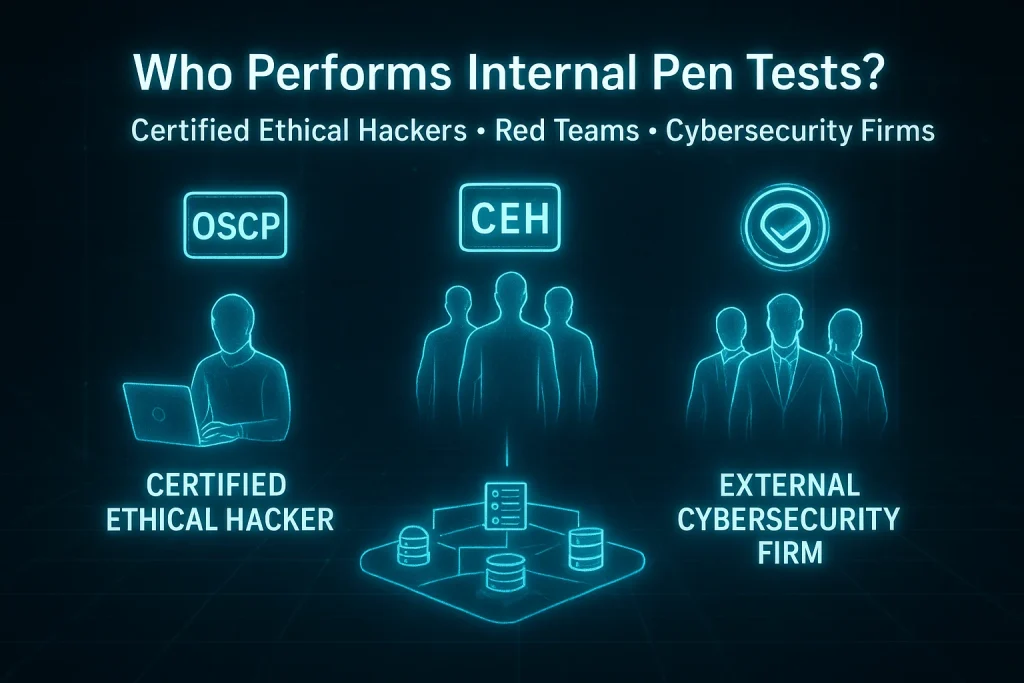
Other than that, some large organizations have their in-house red teams, which handle all the cybersecurity thingy for them, such as validating segmentation and detecting misconfigurations.
While some companies are relying on their in-house security teams, not every company can afford to hire cybersecurity experts like that. So, they go for external, world-class cybersecurity companies to protect them from destructive cyberattacks.
They have highly experienced and professional cybersecurity experts on their team. Normally, to maintain their reputation, these companies go above and beyond for their clients.
The Ultimate Internal Penetration Testing Checklist
Here’s the exact internal penetration test roadmap we follow, which saves our clients from potential cyberattacks and breaches.
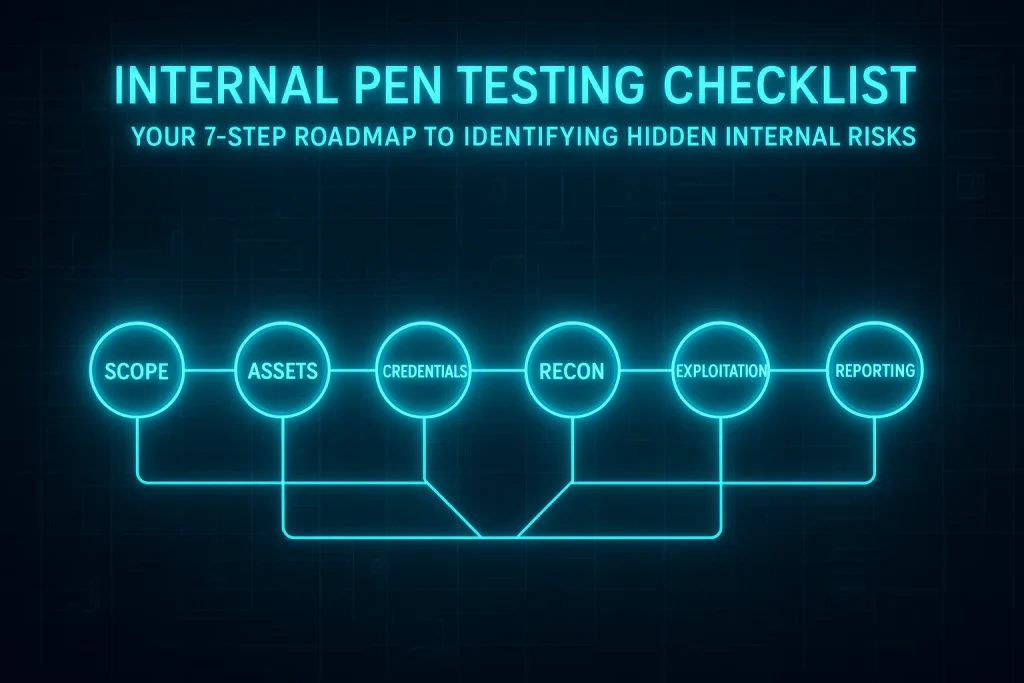
- Scope Definition: This is where the expectations and scope of the penetration test are set between the client/company and the penetration tester. For example, the network segment, the number of hosts, servers, & devices to be included.
- Asset Discovery: It’s where we will discover live hosts, identify open ports, running services, and detect unmanaged or rogue devices. In short, we’ll decipher how far the hacker can exploit the vulnerabilities.
- Credential Analysis: Since most of the cybercriminals exploit identity security loopholes, we usually evaluate user accounts, assess password policies, and identify privileged groups.
- Internal Reconnaissance: Once we understand your network infrastructure, it’s hella easier to scan for vulnerabilities and target them in our penetration test. It usually involves outdated OS versions, unsupported services, missing patches, and software vulnerabilities.
- Lateral Movement: This is where our ethical hacker has a dramatic entry in the scene. Because they start exploiting the flaws in your internal security structure according to the rules of engagement (which were decided during the scope definition step).
- Segmentation: The key activities in this phase include network segmentation testing, access control testing, attempting to transfer sensitive data, and testing firewall rules internally.
- Reporting: This is where we properly create a detailed report and send it to our clients, which usually highlights the list of findings, proof-of-concept evidence, business impact explanation, technical remediation, and security improvements.
Internal vs External Penetration Testing: What’s the Difference?
| Category | Internal Pen Test | External Pen Test |
|---|---|---|
| Primary Objective | To find flaws in the internal security system and analyze how far a hacker can go. | To identify vulnerabilities in the publicly faced systems, such as websites. |
| Attack Perspective | Imitate a cybercriminal as if they were inside the network. | Simulates an external, internal-based attacker. |
| Starting Access Level | It mainly starts with standard user credentials, VPN access, or LAN access. | Anyone with good internet access, with zero access. |
| Scope | Internal servers, workstations, AD, file shares, and internal firewalls. | Websites, APIs, cloud assets, VPN portals, DNS, and email servers. |
| Core Focus Areas | AD security, lateral movement, privilege escalation, and segmentation gaps. | Web vulnerabilities, firewall rules, cloud exposure, and perimeter defenses. |
| Common Techniques | Pass-the-Hash, token abuse, pivoting, and SMB attacks. | Brute force, SQL injection, RCE, SSRF, CMS exploits, and credential stuffing. |
| Visibility to SOC/SIEM | It helps test the detection of lateral movement, privilege escalation, and suspicious internal behavior. | Tests the detection of scanning, exploitation attempts, and login abuse from outside the system. |
| Authentication Level | Mostly authenticated with domain credentials. | Only authenticated for web app or cloud testing. |
| Target Systems | AD, file servers, domain controllers, internal apps, IoT, WiFi. | Websites, APIs, CDN assets, SMTP servers, and cloud endpoints. |
| Movement Ability | It often includes pivoting and lateral movements across the systems. | No lateral movement, focus is one initial entry only. |
| Impact Demonstrated | It demonstrates how much a hacker can do inside the network. | Shows if an attacker can break into your system. |
| Required Access | LAN, on-site presence, VPN, or jump box. | Internet access only. |
| Business Value | Minimizes the internal breach impact, strengthens overall security. | It saves systems and networks from breaches and cyberattacks. |
| Typical Duration | Anywhere between 5–12 business days. | 3–10 days, depending on external footprint. |
Why Businesses Should Opt For Internal Penetration Tests in 2026?
The fact of the matter is, AI-driven malware is getting harder and harder to detect with each passing day. The ransomware gangs are now smart enough to target the back infrastructure first.
On top of that, internal threats are increasing drastically, but you can’t detect them easily. Ultimately, you can’t protect your network if your internal system isn’t strong enough and tested frequently by professional penetration testers.
That’s A Wrap, People!
What happens when you keep getting your internal security tested over and over again? You build a repeatable and measurable security posture that keeps improving over time. You don’t just rely on your protected firewalls but on a strong, reliable internal structure that is too hard to exploit, even for expert hackers.
In the end, it’s just a win-win scenario for your business or organization. So, if that’s something you want for your baby, aka your company, get a FREE Consultation for your internal network.
Frequently Asked Questions
How long does an internal penetration test usually take?
Usually, it takes anywhere between 3 days and 3 weeks, depending on the project size, network complexity, and the experience of the company you have hired.
Will an internal penetration test disrupt normal business operations?
A properly planned and executed penetration test will not cause any outages. However, the internal penetration test might cause a slowdown in your business operations temporarily.
Can internal penetration testing be done remotely?
Yup, that’s doable and already done by the ethical hackers around the globe. They need a secure VPN, a jump box, or a dedicated virtual machine, and they can perform remote internal penetration testing.
What should organizations prepare before an internal pen test begins?
The basic preparation includes informing the stakeholders about the testing schedule, providing updated network diagrams, identifying critical systems that must not be disrupted, and whitelisting tester IPs in monitoring tools to avoid false alarms.
Is internal penetration testing required for compliance?
PCI-DSS, HIPAA, ISO 27001, NIST 800-53, and SOC 2 either require or highly recommend internal infrastructure penetration testing every once in a while.