External Penetration Testing: Definition, Importance, Checklist, and Top 10 Tools
Every other business faces data breaches and hacking attacks at least once or twice. But do you know that 84% of organizations faced it because they had at least one public-facing neglected asset? That’s thought-provoking, isn’t it?
The solution: External penetration testing (aka external network penetration test). The penetration tester helps you see what you and your team couldn’t see for a long time. How? They use years of cybersecurity knowledge and experience to uncover hidden entry points of hackers.
This guide is dedicated to the external penetration testing definition, why it matters for your business, the checklist, and the top 10 tools used by the industry-leading penetration testers.
What is External Penetration Testing?
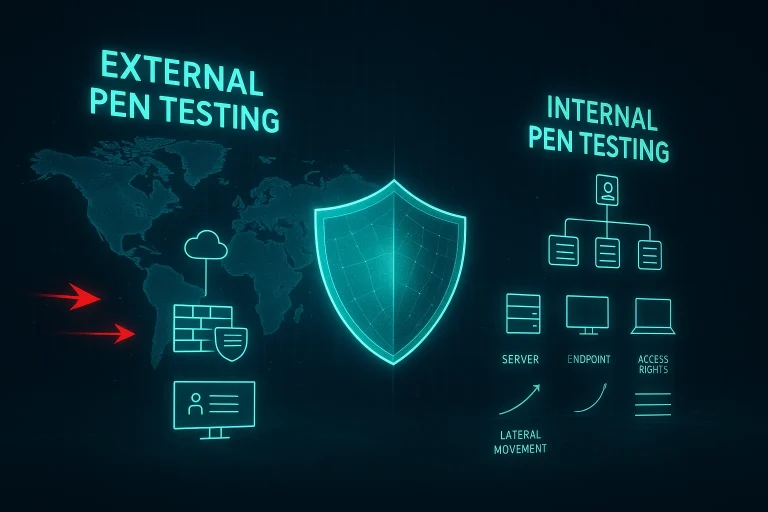
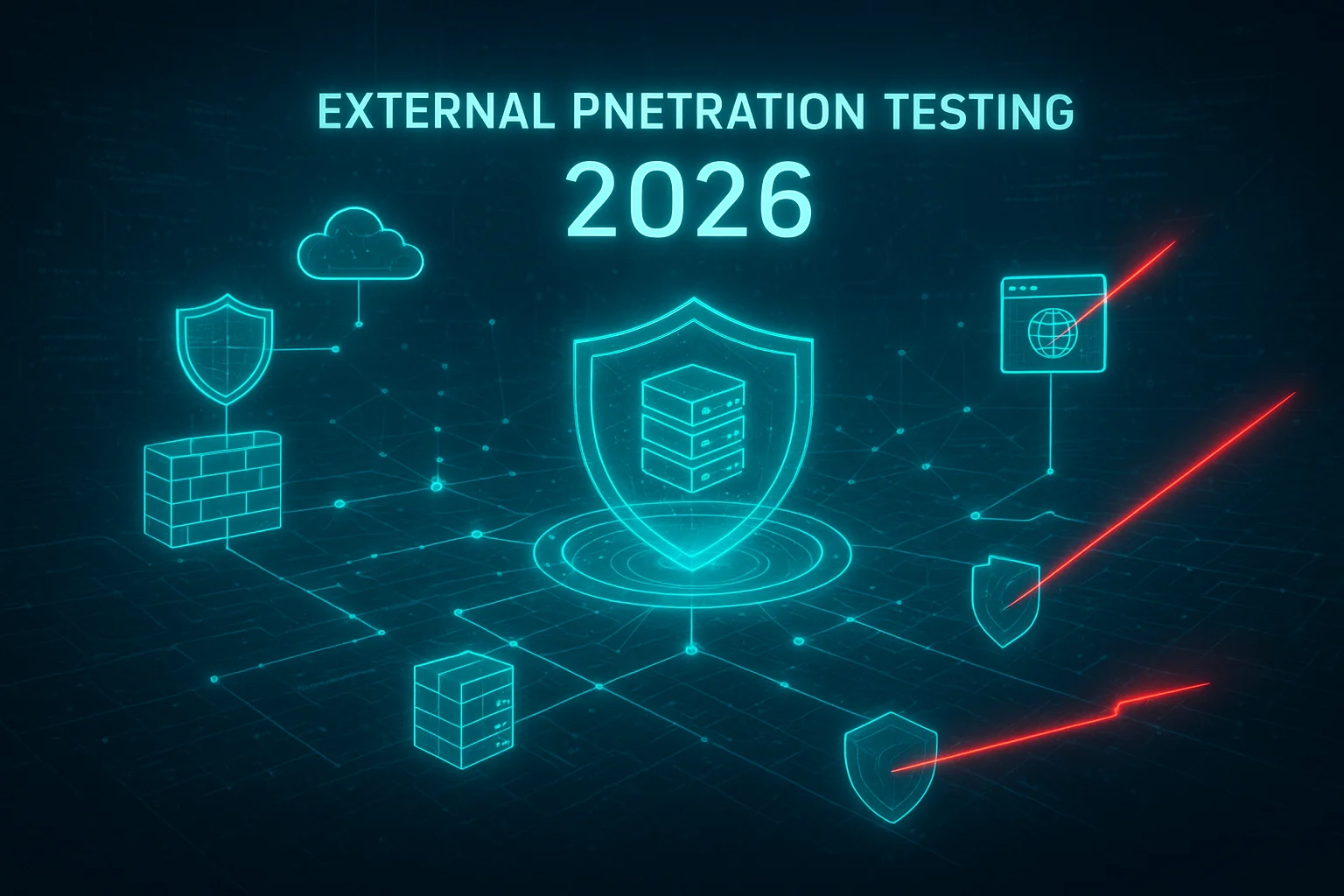
External penetration testing refers to the process in which a professional penetration tester imitates real-world cybercriminals and identifies & exploits the security vulnerabilities. It involves all the digital assets that are publicly accessible, such as websites, web applications, email servers, VPN gateways, cloud environments, DNS records, and more.
The moment you put a website, an API, an email system, or a cloud app online, a hacker is already waiting to scan it for vulnerabilities. And if your asset has open ports, identity exposure, misconfigured firewalls, or leaking data, you might have already been infected, congrats 😣.
Wanna learn how our team of professional external network penetration testers prevents that from happening? Keep reading.
The “No-Room-For-Internet-Morons” External Penetration Testing Checklist
This is our secret tool to catch the data breaches before they happen for our clients, because of the in-depth external penetration methodology our team follows. And here it goes:
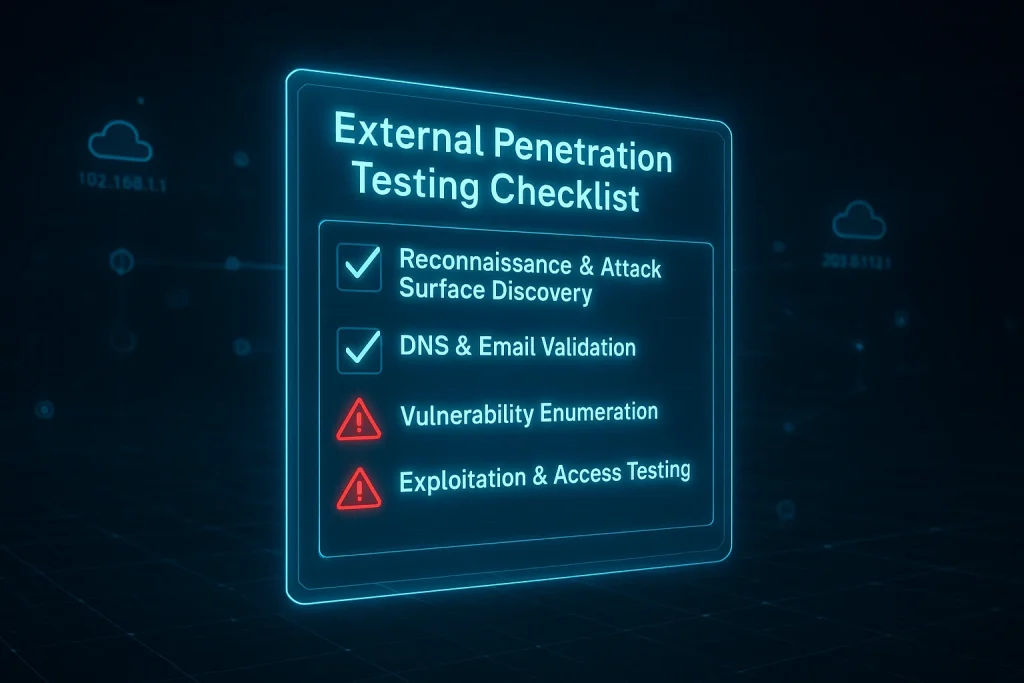
1. Attack Surface Discovery & Reconnaissance
This is a phase we take too seriously because it will determine the accuracy of our external network penetration test. To do that, first of all, we collect every single information publicly available about our client, just like the hackers. And it goes like this:
- We bring light to the root domains, all the associated domains, and check the name servers, registrars, and hosting providers. Then, we move to sub-domains and IP address identification because they’re often ignored while being highly vulnerable.
- If you have cloud assets, that’s our next target in the information gathering phase. Because, as you must be aware, many breaches originate from misconfigured cloud assets. And we need to make sure you don’t have one.
- Do you know that a hacker can break into your system by just knowing what type of tech you’re using to run your system? Scary, isn’t it? We make it safer for you by identifying misconfigurations, weak technologies, version vulnerabilities, and known CVEs.
- Then, we focus on gathering organizational intelligence, such as email enumeration, and employee roles & privilege mapping.
Once we’re done with the in-depth surface discovery, we discover the full lists of domains & subdomains, the full list of public IPs, server & application fingerprinting, internal intelligence discovered, shadow IT, and all services running on the perimeter.
2. DNS & Email Security Validation
As the name suggests, this phase is entirely dedicated to analyzing how your business’s DNS records, email configuration, and domain infrastructure are set up. And it matters because any simple misconfiguration can redirect your visitors to malicious sites. Here are the key components in DNS & email security validation:
- We examine all core DNS records to see if there are any incorrect entries, exposed records, and DNS entries pointing to old servers.
- In email authentication validation, we usually follow these three methods: SPF (Send Policy Framework), DKIM (DomainKeys Identified Mail), and DMARC (Domain-based Message Authentication Reporting & Conformance).
- Then, validating mail server security comes in the pipeline. We check for open mail relays, SMTP banner information leakage, misconfigured MX records, and exposed admin panels.
This stage covers everything related to DNS & email security and makes sure your email and domain infrastructure can survive any manipulation.
3. External Service & Vulnerability Enumeration
To prevent your service vulnerabilities from being exploited by hackers, we check for open ports, software versions, and misconfigurations before simulating to exploit them. Because we follow what hackers do, and they always map out your weak perimeter first and then attack. Here’s how it goes:
- To detect any open ports, closed ports that reveal unnecessary details, and filtered ports through port scanning. Then, we move on to service fingerprinting, which helps massively in identifying known vulnerabilities in your exact environment.
- We mix and match automated tools and manual validation to scan for vulnerabilities such as open directories, weak default configurations, and weak TLS/SSL to identify possible entry points for penetration testing.
- Moving on, we validate SSL/TLS certificate validation, check for metadata leaks, and test weak services.
And that leads us to a strategy in which we prioritize the attack paths to exploit those vulnerabilities during this phase.
4. Exploitation Attempts & Access Testing
While going wild with the security vulnerabilities in your system is a crucial part of external penetration testing, we do it in a controlled way. In a way, that doesn’t disrupt your business operations and services. Here’s what we do in this phase of external penetration testing:
- We evaluate the login portals, admin interfaces, and VPNs through password spraying, weak credential testing, and multi-factor authentication (MFA) verification.
- We check if the authorization bypasses, and restricted data can be accessed, because that uncovers the business logic flaws before you face a heavy loss.
- Weak third-party integrations might give a chance to the exploiters, even if your external network is highly secure. So, we test the external APIs, cloud services, SaaS integrations, and payment gateways to check if they’re secure or not.
- During the exploitation, if we’re able to break into your system, we move on to the next step: escalating privileges within the system. And we try to access restricted resources to identify how far a hacker can move laterally to your other systems.
5. Exploitation Attempts & Access Testing
This phase is more like a wind-up of the whole external penetration testing campaign. It’s all about hardening your external security layer against cyber threats through identifying loopholes and giving you recommendations accordingly. Here’s how it typically goes:
- Through OSINT-based leakage investigation, we’re able to identify employee email leaks, tech stack information leaked in public forums, DNS history exposure, public GitHub code leaks, and password dumps.
- We offer recommendations to make your system more secure and stronger against the continuous and increasing cyber threats. The recommendations depend on the vulnerabilities of your system.
- Finally, we send you an in-depth report which includes every vulnerability found, its risk level, how the exploit works, proof-of-concept (PoC) evidence, and how you can fix all these for both immediate and long-term security.
Why External Penetration Testing Matters For Businesses & Organizations?
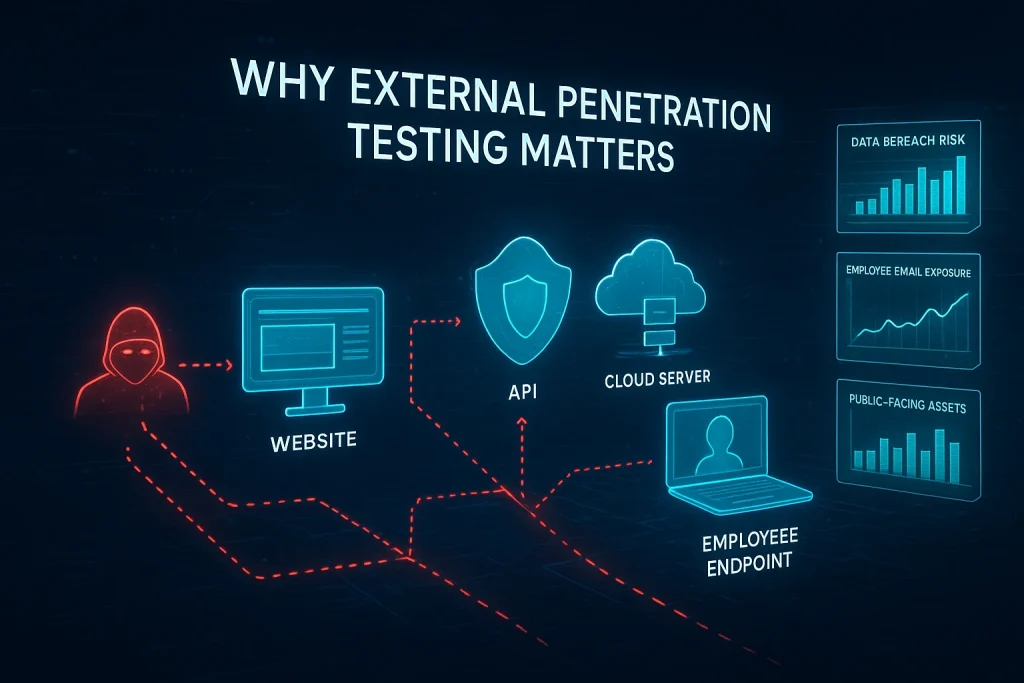
Every business is responsible for getting penetration testing done, whether it’s internal or external network penetration testing. Why? A simple reason: your customers trust you with their sensitive data. And now, it’d be such an injustice to them if you can’t protect their data from cyber criminals.
It might not make a difference immediately, but it will deeply affect your business reputation and customer retention negatively. External penetration testing is an incredible way to see the documented proof of the vulnerabilities in your systems and how they can damage your business. So, you can take precautions before you face an actual cyber attack.
The Ultimate List of External Security Testing Tools
| Tool Name | Type | Primary Function | Why It’s Recommended |
|---|---|---|---|
| Nmap | Automated & Manual | Network scanning, port discovery, service detection enumeration | Industry-leading tool known for its world-class quality |
| Shodan | Automated | Internet-connected device discovery | It helps you find exposed devices and services on the internet |
| Nessus | Automated | Vulnerability assessment | A no-brainer when it comes to vulnerability database and easy reporting |
| OpenVAS | Manual & Automated | Vulnerability scanning | It’s a free, open-source alternative to Nessus with plugin support |
| Nikto | Automated | Web server scanning | It helps in quickly detecting outdated servers, misconfigurations, and known vulnerabilities |
| Burp Suite Professional | Manual & Automated | Web application testing and vulnerability exploitation | A beast for manual testing and manipulating requests |
| Metasploit Framework | Manual & Automated | Exploitation framework | Used for safe testing and validating security flaws |
| Amass | Automated | Subdomain enumeration, reconnaissance | It helps during mapping and identifying forgotten assets |
| Wireshark | Manual | Network traffic analysis | It’s highly efficient in catching & inspecting misconfigurations and insecure communication |
| OWASP ZAP | Automated & Manual | Web application security scanning | A free, open-source tool that makes web vulnerability scans easier |
Frequently Asked Questions (FAQs)
Does external penetration testing also detect vulnerabilities caused by third-party integrations?
Yup, but that depends on the rules of engagement set by the client. If your business is heavily relying on third-party SaaS apps, APIs, payment gateways, or even vendor-hosted systems, your penetration tester should definitely scan how these third-party tools are affecting your business security.
Can an external penetration test reveal if my attack surface is larger than I think?
Absolutely. In fact, that’s one of the key objectives of external penetration testing. While the businesses and organizations think they’re secure but penetration testers often find forgotten subdomains, legacy applications being publicly accessible, misconfigured cloud storage, just to mention a few.
Will an external pentest identify business logic flaws or only technical vulnerabilities?
While it’s mainly focused on the technical part, it can also uncover certain business logic flaws. And especially in web applications or APIs, by exploiting multi-step authentication.
Can external penetration testing detect zero‑day vulnerabilities?
Nope, not really. Traditional external penetration testing focuses on known vulnerabilities with documented exploits and security gaps in exposed services.
Does external pentesting assess how quickly my security team detects and responds to live attacks?
Contrary to what external penetration testing usually does, if you want to focus on detection response capabilities, you should opt for a red team-style penetration test approach.
The Bottom Line
External penetration testing doesn’t just make your system stronger against security threats but also raises awareness among the staff and stakeholders. This cultural shift will go a long way in protecting you from such cybercriminals. Plus, it helps you invest strategically to strengthen your overall security because the report will show you where the biggest risk lies.
And if that’s something you want for your business, we’re here to help you. Claim a FREE External Penetration Security Audit today and make your business strong enough to handle data breaches and hacking attempts.